NOVEMBER 2024
apartments design guides can do more bad than good
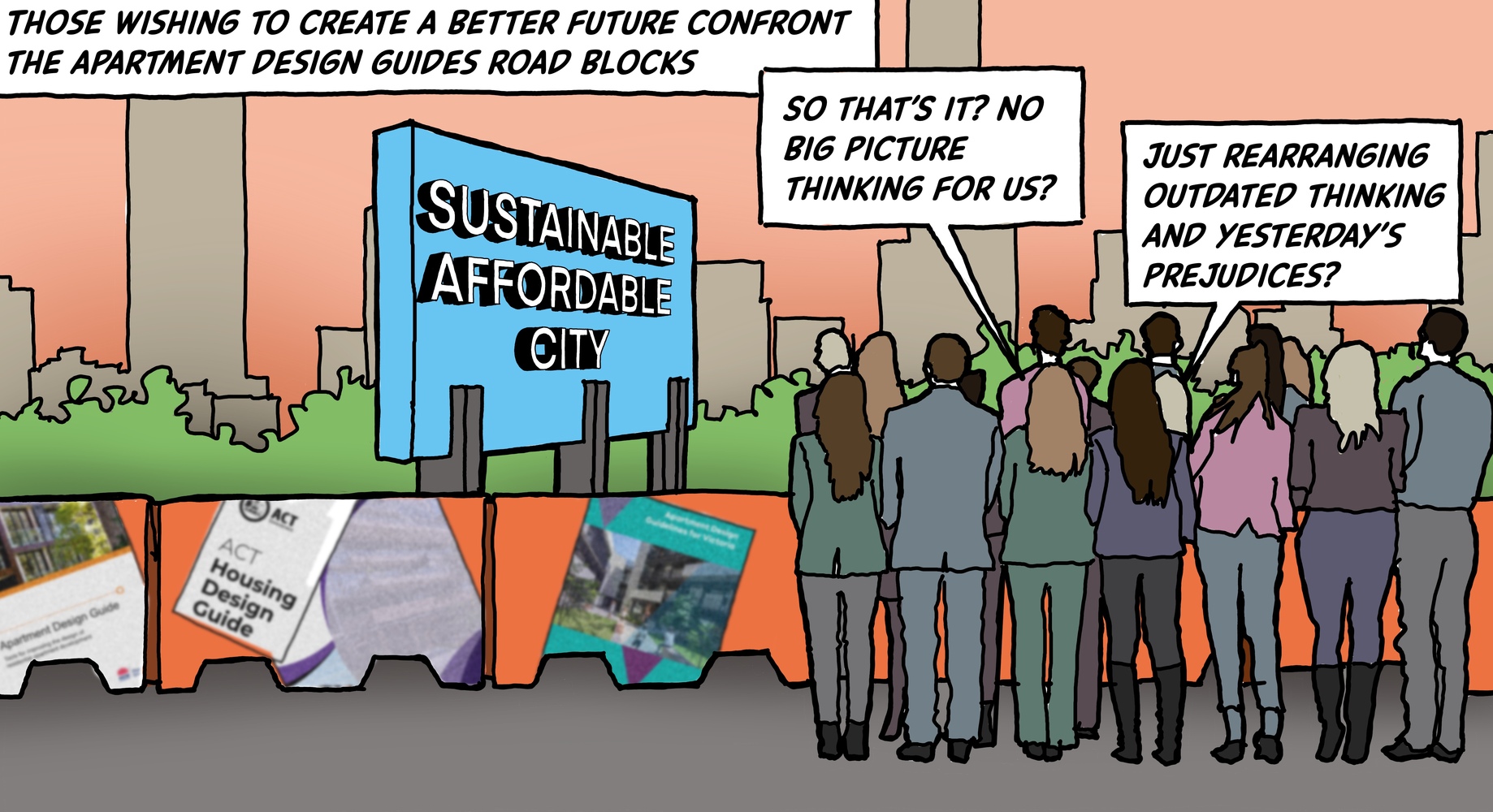
By now I could barely hold back my astonishment. "You are completely wrong!" I said to the statutory planner from the state planning department.
A short while into my presentation some years ago of a mixed use residential and aged care building the planner had become fixated on the aged care suites. "These won't comply with the better apartment design standards" they said.
"Of course not." I replied. "They don't have to. They are aged care suites. They are not a residential use, and so the BADS don't apply."
"Yes they do. You'll have to change the design so they comply." was the immediate- and incorrect- rebuttal.
An example- perhaps extreme, but no less real- of how design standards can limit analysis.
Apartments are inherently more energy efficient than houses. They are smaller, and therefore need less heating and cooling. They typically have only one outside wall meeting the outside environment, whereas houses have four walls plus roof and floor. The quickest way to reduce our collective carbon footprint from housing is therefore to encourage a greater number of apartments. And if those apartments are built near employment opportunities or public transport we get the double benefit of reducing our transport and infrastructure carbon footprint.
The CoolClimate Network maps produced by Berkely University are a fascinating insight into the carbon footprint of every zip code in the USA. It's worth looking at the five boroughs of New York City, appearing as an oasis of low carbon footprint when compared with the surrounding lower density areas. The population of New York City is 70% of that of the combined population of greater Melbourne and Sydney, but it does that in an area only 3.5% of the total extent of those two cities. The primary reason New York City has one of the lowest carbon footprints in the USA is because the majority of people live in apartments and the density allows most people to walk, cycle or use public transport when commuting.
Somehow that city has managed to have a long history of apartment living without resorting to apartment design guides. It shows how effective the simple precepts of living smaller and closer can be in reducing city-wide energy consumption.
However apartment design standards make that harder to achieve. Those standards typically make apartment buildings less efficient. They do that by making apartments wider than they need to be, and less deep than they can be, resulting in fewer apartments. They do that by requiring cross ventilation, which has the effect of pushing apartments apart. They do that by mandating apartments to face the sun, which limits where apartments can be placed. They do that by setting apartment ceiling heights to be higher than for houses, resulting in fewer apartments that can be contained within a building.
Unless we compensate by making buildings taller, those standards reduce the density of our cities. That reduced density means we displace potential residents to places further out, resulting in increased transport and infrastructure energy consumption for our cities.
In attempting to gain marginal improvements in the environmental performance of individual apartment buildings, we are making the aggregate environmental performance of cities worse because the resultant increase in city-wide carbon footprint outweighs those marginal improvements.
At the same time the apartment design guide interventions make apartments more expensive. In Australia therefore while shutting down the exploration of different and potentially better solutions, the design standards for apartments have led to less affordable housing and almost certainly resulted in more energy consumption overall.
The advantages of density were highlighted in a recent NSW productivity and Equality Commission review of housing supply challenges in that State. That report also contained the very sensible suggestions of allowing smaller apartments than currently mandated by apartment design guides, and to stop being fixated on providing sun infiltration into apartments. You would think that such sensible suggestions providing greater flexibility of design outcome would have received immediate support from architects. That hasn't happened. It is interesting to explore why that might be.
Architects by training synthesise disparate strands of information and influence into a compelling idea and narrative. Therefore we are well placed to see the "big picture" instead of being obsessed by the detail. Unfortunately that doesn't always appear to be what actually happens- instead we can be sidetracked by detail and the satisfaction and acclamation that accompanies mastery of that detail. Reputations can be built by optimising the environmental performance of a single building. That accomplishment is real and palpable. The down-stream impacts of the resultant lower city density and resident displacement can be seen to be theoretical, and someone else's problem. They are therefore ignored.
It is that singularity, detail of focus and intentional lack of awareness of broader consequences which underpin the apartment design standards.
Design standards represent the death of innovation and learning. They freeze knowledge and experience. By discouraging different solutions they prevent improvement. The embodied hubris- that the outcomes represented in the design guides are best that can be achieved- is discomfiting. Even when they are "guides" rather than standards, they become the de facto design solution for planning authorities, and arguing for better solutions becomes fruitless and drawn-out.
Yet these guides are often supported by architects. Even if they are not good for design, perhaps they are good for business? The Apartment Design Guide for Victoria runs to 74 pages. But that is a lightweight compared with the NSW Apartment Guide at 181 pages of joy. Canberra, less than one tenth the population of Melbourne, nevertheless manages to produce a design guide 98 pages in length. Tackling these guides is not for the faint-hearted, and so building developers naturally turn to architects to navigate through them.
Perhaps the NSW Productivity and Equality Commission report is an early harbinger of a reconsideration of the value of apartment design guides. I find myself reflecting on a submission I made to the 2008 Australian Parliament Joint Standing Committee on the National Capital and External Territories enquiry into the National Capital Authority. In that submission I said "The working methodology [of the NCA] is one of dialogue and interaction, of positive persuasion in preference to the limitations of prescription." It used to be that planning schemes were the expression of strategic aims, building designs explored site-specific opportunities within that strategy, and the planning application represented the opportunity to interrogate individual opportunity within collective aspiration. Perhaps it would be better for housing sustainability and affordability if we returned to that approach.